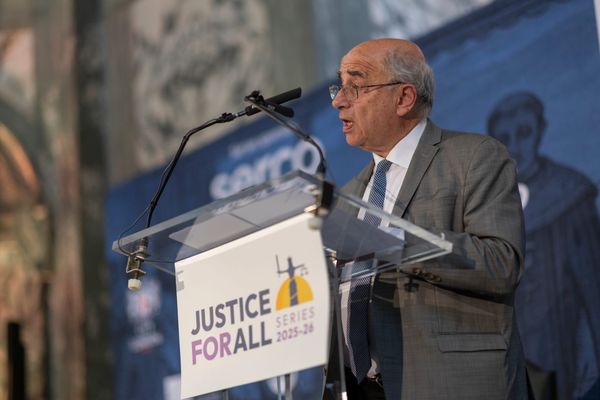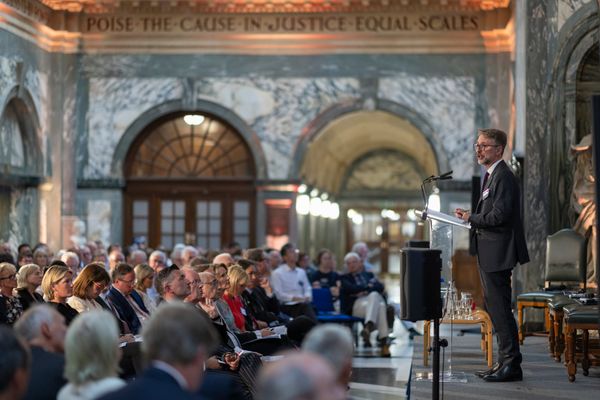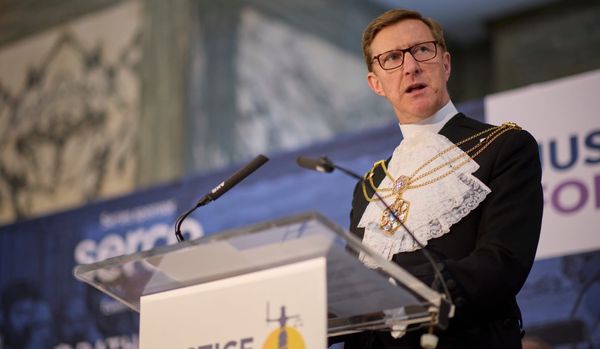
Address given by Her Honour Wendy Joseph KC

The Annual General Meeting of the Sheriffs’ & Recorder’s Fund in Court No.1 at the Central Criminal Court on Wednesday 1st July 2026.
I have over the years so often walked into this court to a roomful of people, in the dock, the jury box, counsel’s rows. None of them looked like you. With them, it was obvious what I was here for. With you, perhaps less so.
The purpose of someone talking to you at this point is to thank you – very much – for your generosity in supporting the fund with your money, your time and your enthusiasm. I do thank you, and from the heart. The purpose of it being me who does the talking is, I suppose, because I appeared as counsel or sat as a judge in this building for nearly 50 years.

I defended - explaining to juries exactly why they should acquit those in the dock. Then I prosecuted - explaining to juries exactly why they should convict those in the dock. Perhaps more importantly from tonight’s point of view, I sat in this seat behind this Bench and sent hundreds and hundreds and hundreds of people to prison.
I did it because it was my job, not to make law, but to apply law which, these days, is largely made by those whom society has elected to represent it – which you elected to represent you. The application of that law is called the doing of justice and that was my job. But if I’m honest, I’ve never been entirely clear what we mean by ‘doing justice’.
In civil courts it’s obvious because there, doing justice means putting the parties back where they would have been if one of them hadn’t been a rotter and breached their contract, committed a tort, blocked a right of light or breached a copyright. In those courts putting things back as they should have been doing justice. But you can’t do that in criminal courts. You can’t undead a dead body, you can’t un-rape a violated child.
So what is it I was doing when I followed the law and locked up convicted defendants? I was following the will of Parliament – the will of society – which declared that a just sentence required:
- Protecting society from dangerous offenders. The mantra was and is ‘lock ‘em up’
- Deterring others from offending. The mantra remains do it by ‘locking offenders up’
- Pure punishment. He mantra, of course is, ‘lock ‘em up, and for a long time’.
- The 4th element – rehabilitation, at least in the minds of the press and perhaps rather too many of the public, comes a long way down the list.

I’ve become increasingly persuaded over half a century working in that system, that we’ve got it wrong. And if we haven’t got the system wrong, we’ve surely got the emphasis wrong. Our laws seem to be about catching and punishing those who break them, but they’re not. Laws are there to say, ‘in an orderly and happy society these are the behaviours we will not tolerate, and if you commit them, we will stop you. Because we cannot all live together in peace and harmony if you persist in offending in this way’.
As soon as I say that, it is obvious that the purpose of having laws is not to catch and punish people who commit crime, but to aim for a position where people do not commit crime … where prisons are empty because the courts are empty and all the judges are on the dole. Of course, we are never going to achieve that but isn’t that what we actually want and should be aspiring to.
And as soon as I say that it becomes clear that when a judge looks at the factors relevant to sentencing, rehabilitation should be not at the bottom of the list but pretty much at the top, at least where a defendant is capable of being rehabilitated. Incarcerating them in a way they can’t be rehabilitated should be reserved for those so dangerous, they can’t be allowed to live amongst the rest of us. That is the tiniest fraction of the nearly 90K people currently in prison.
As for those who can be rehabilitated – well, of course where the crime merits a term of imprisonment, they must serve it; but what point is there in locking people up for so long they become institutionalised. Still, for the time they are locked up, shouldn’t the emphasis be on rehabilitative work. But successive governments have provided so little of this, it’s become an embarrassment.
And when prisoners are released wouldn’t it be in all our interests to help them into work and provide support for addictions and mental illness … instead of giving them a tent and £80 and saying good luck and see you on your way back inside. So much of the work of support – in so far as it exists at all – is today, being done by people like you, people like those who run the Sheriffs’ and Recorder’s Fund. Which brings me onto why we’re all here today.
For many, many years the Sheriffs’ and Recorder’s Fund has supported prisoners, and the need now is greater than it has been for a long time. The aim was always to help ex-prisoners to help themselves stay out of prison. Which for most of them has meant trying to get into work. But you try applying for a job when you have no home, no bed to sleep in, no bathroom to wash in, no clothes to wear to an interview. You try holding down a job when you have no training or if you have, no tools. With all this the SRF has traditionally helped. But more recently the fund has come to understand – as we all have – that an ex-prisoner, if he / she is to make a new life, needs support for the whole person. Of course, those with drug or drink addictions need help. Of course, those without skills need training. But the managing of a new life is more than this. It involves changing from being a person who did not fit in with the rest of society to one who does. It involves filling in the gaps that led to their being unable to do that in the beginning. Those gaps often came from society’s failure to see them safely through their formative years. Sometimes those gaps were due to lack of opportunities for education because of a chaotic childhood. Sometimes they were due to failures of the school system to recognise a child had special needs. Sometimes it was because a child was too hungry or too traumatised to concentrate at school. There is a myriad of reasons why people fall into crime.
I saw a lot of those people in the docks in this building. And seeing them, I could not help being struck by the extraordinary number who lacked the basic skills you and your children take for granted. The most obvious was the skill to read. Over and over, I saw it, and I knew it was reflected in the prison population where over half of prisoners are functionally illiterate and 47% have a reading age below what we expect from a five year old.
If you can’t read, certain things follow. You may wish to lead a law-abiding life, but you can’t fill in a job application form and are in any event excluded from a huge number of available jobs. You’ve got a major problem learning to drive or getting a licence. You can’t read the letter from the electricity board saying they’re going to cut off your supply but if you have real hardship let them know. The list of disadvantages is endless. But there is another feature which you might think is even more undermining, and I became aware of it some time ago.
What I noticed was that many of the youngsters in the dock seemed not to understand the pain and damage their actions had inflicted. They seemed to lack the skill for basic empathy. That, of course, is a classic feature of psychopathy but these kids weren’t psychopathic. And I noticed too that so many of them couldn’t read. Which was when it dawned on me that one essential way the rest of us learn from a very young age to appreciate what is going on in someone else’s head is through reading. We read stories where the author puts us, in someone’s thoughts and emotions. It’s irrelevant whether that head is real or fictional. The reader is inside them. You can’t learn empathy from playing video war games. You can’t learn it on social media. You can learn it through reading stories.
This recognition was of particular interest to me because I was to retire in March 2022 and had written a book which was to be published three months after that. I was at a crossroads where law met reading. And so, I was presented with the perfect opportunity to try to do something – even a small something – to support that group of people, so many of whom I had put in prison.
I couldn’t have done it without the help of the Sheriffs’ and Recorders’ Fund – but with a little injection of money from the book’s advance (what better use could there have been for it), we chose a prison with young prisoners (aged 18 – 26), and put in for a 3 year term a teacher who, with the Prison Governor worked tirelessly to provide a basket of reading opportunities. It took a while to make it work, and there were setbacks, but in the end it proved successful. Some of the men were starting to read, others wanted to hone their skills, a few were aspiring to formal qualifications, and all were enjoying books. Two book clubs, two reading groups were established. They were well attended and eager discussion took place. Shelves on wings were well stocked with books. Some were broadcast over the prison radio. The project flourished, and I am told is now self-perpetuating. It’s improving the lives of those inside and will continue to do so when they leave. They’re becoming different people.
And that is what the Sheriffs’ and Recorders’ Fund does. It’s what they can do with your money as well as mine. And it’s not just about reading. There are a myriad of projects ongoing and in the planning. Long may it continue.
HH Wendy Joseph KC
Author of Unlawful Killings, and Rough Justice