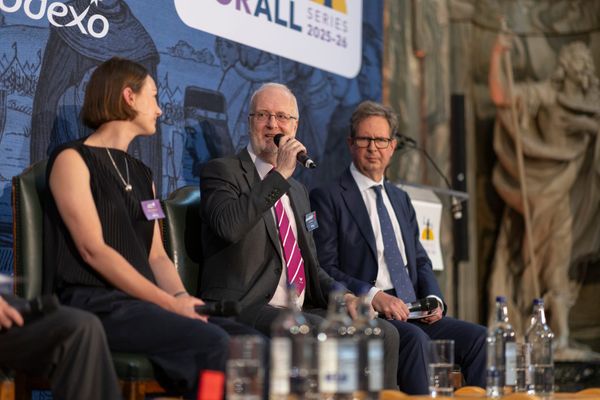
Justice for All: The Power of Collaboration to Drive Systemic Change

Over the past year, I have had the privilege of supporting the Justice for All Series, a cross-sector initiative convened and led by Alderman and Sheriff Robert Hughes-Penney of the City of London Corporation. Through my role at DWF, I helped bring together leaders from the justice sector including business, government, judiciary, academia, charities and organisations representing those with lived experience of the justice system to explore practical solutions to some of society’s most complex challenges.
While the events themselves created valuable opportunities for discussion and learning, the real success of the Series has been its ability to convert dialogue into action. Across five events from October 2025 – June 2026 hosted at the Old Bailey and attended by more than 540 participants, the programme facilitated new partnerships, strengthened existing relationships and created connections between organisations that would not normally collaborate. Participants reported that the Series opened access to influential networks, generated opportunities for strategic partnership, informed organisational thinking and created pathways for continued engagement on justice issues.
One of the most significant outcomes was the ability to bring lived experience into conversations traditionally dominated by institutions. Participants consistently highlighted the value of hearing directly from individuals affected by the justice system, helping decision-makers better understand the human impact of policy, operational and funding decisions. These conversations challenged assumptions, broadened perspectives and helped identify opportunities for reform and innovation.
The Series also demonstrated the importance of collaboration in tackling systemic challenges. Issues such as rehabilitation, victim support, social mobility, access to justice and reducing reoffending cannot be solved by a single organisation acting alone. By creating a trusted environment where diverse voices could engage in constructive dialogue, the programme helped build the relationships and understanding needed to address these interconnected issues more effectively. Over 100+ organisations were involved in the Series, including four sponsors (Rathbones, Serco, Sodexo and City of London Corporation), five supporters (DWF, TechStart, PA Consulting, Magna Carta Trust, RAND Europe) and over 20 charities.
Personally, the Justice for All Series reinforced a principle that sits at the heart of Intelligent Ethics: meaningful change happens when organisations move beyond individual interests and work together around a shared purpose. The most valuable outcome was not simply the number of attendees or events delivered, but the creation of a growing community committed to improving justice outcomes through collaboration, ethical leadership and collective action. This is ultimately how lasting social impact is achieved and I am proud to have played a role in making that happen.
Author’s note: Through DWF’s involvement in the Series, I assisted in the design of programme content including successfully applying for Continuing Professional Development (CPD) accreditation, facilitation of stakeholder engagement, managing senior stakeholder relationships, and developing the governance and risk framework to support the Series.
In addition, my role critically included driving the development and delivery of legacy outcomes including the Justice for All Book (to be published in Sept 2026) and a Justice Policy Lab which will act as a catalyst for translating cross-sector collaboration into integrated reform and practical action on justice-system change.
Tracey Groves
https://intelligentethics.com